ADLAS
Your analysis kit
The ADLAS-Core is your work surface: decoders, lenses, overlays, and measuring templates interlock on it and make visible what you would otherwise miss. You receive the kit once and work with it for years.
File 000 · Recruitment phase open
A place changes overnight. A document tells a story no one else remembers. The Institute collects cases like these and tries to work out what rules lie behind them. As an investigator you get the kit, access to the archive, and a file no one has found the answer to yet.
Physical kit Digital archive Ongoing cases
Free, no strings, done in under a minute. Founding investigators get updates and hear about the launch first.
System Access · Guest Log
> CONNECTION TO AIMS ESTABLISHED
> AUTHENTICATION ... GUEST PROFILE ACTIVE
> CLEARANCE: R0 · PUBLIC RECRUITMENT ACCESS
> SYNCHRONISING ARCHIVE ... REFERENCE DATA LOADED
> SEARCHING RELEASED INVESTIGATION FILES ...
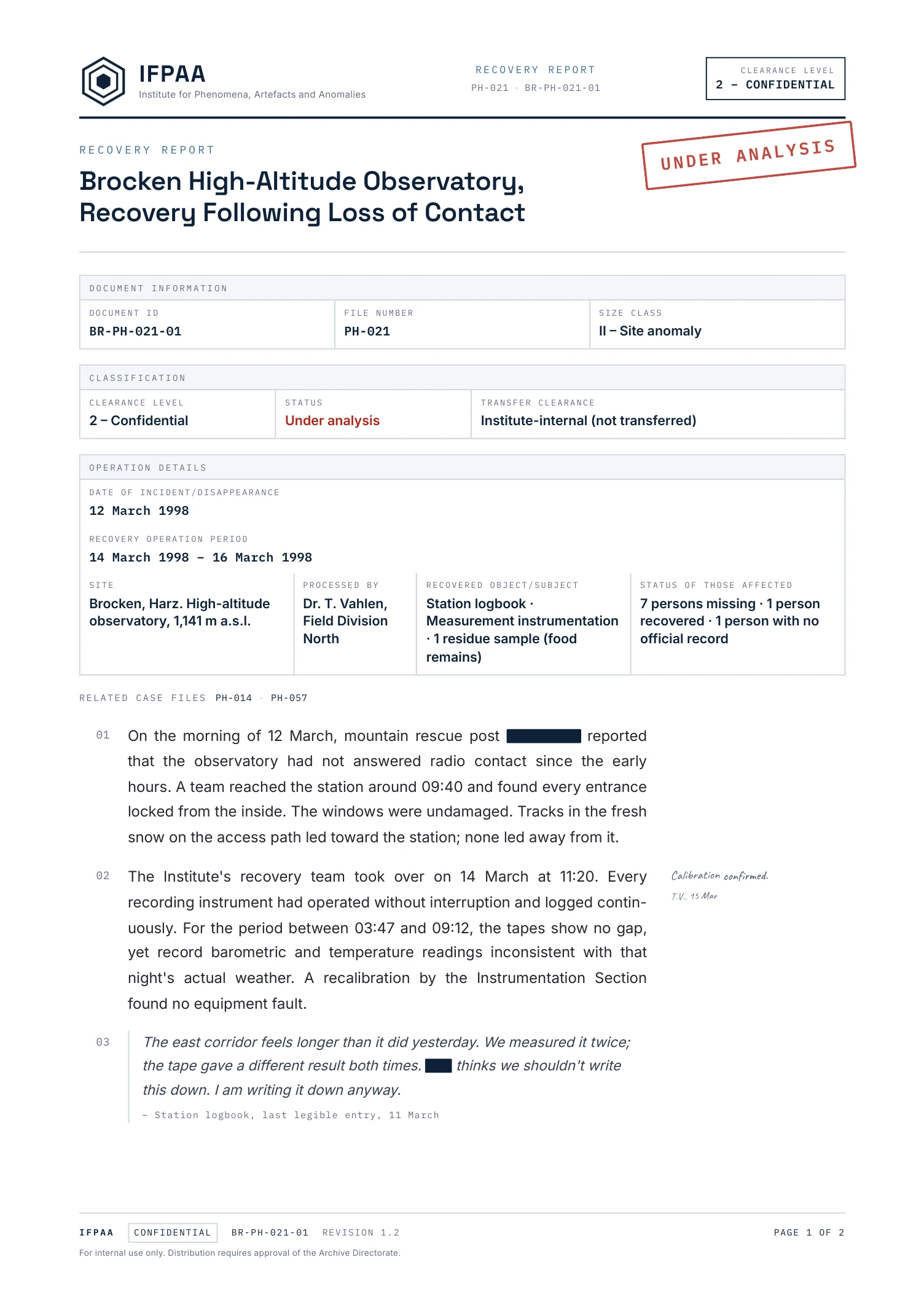
> CASE FILE PH-021 · BROCKEN HIGH-ALTITUDE OBSERVATORY
> INCIDENT: 12 MARCH 1998 · RECOVERY 14–16 MARCH 1998
> INVESTIGATION STATUS: UNDER ANALYSIS · OPEN SINCE 1998
> PRELIMINARY CLASSIFICATION: CLASS II · SITE ANOMALY
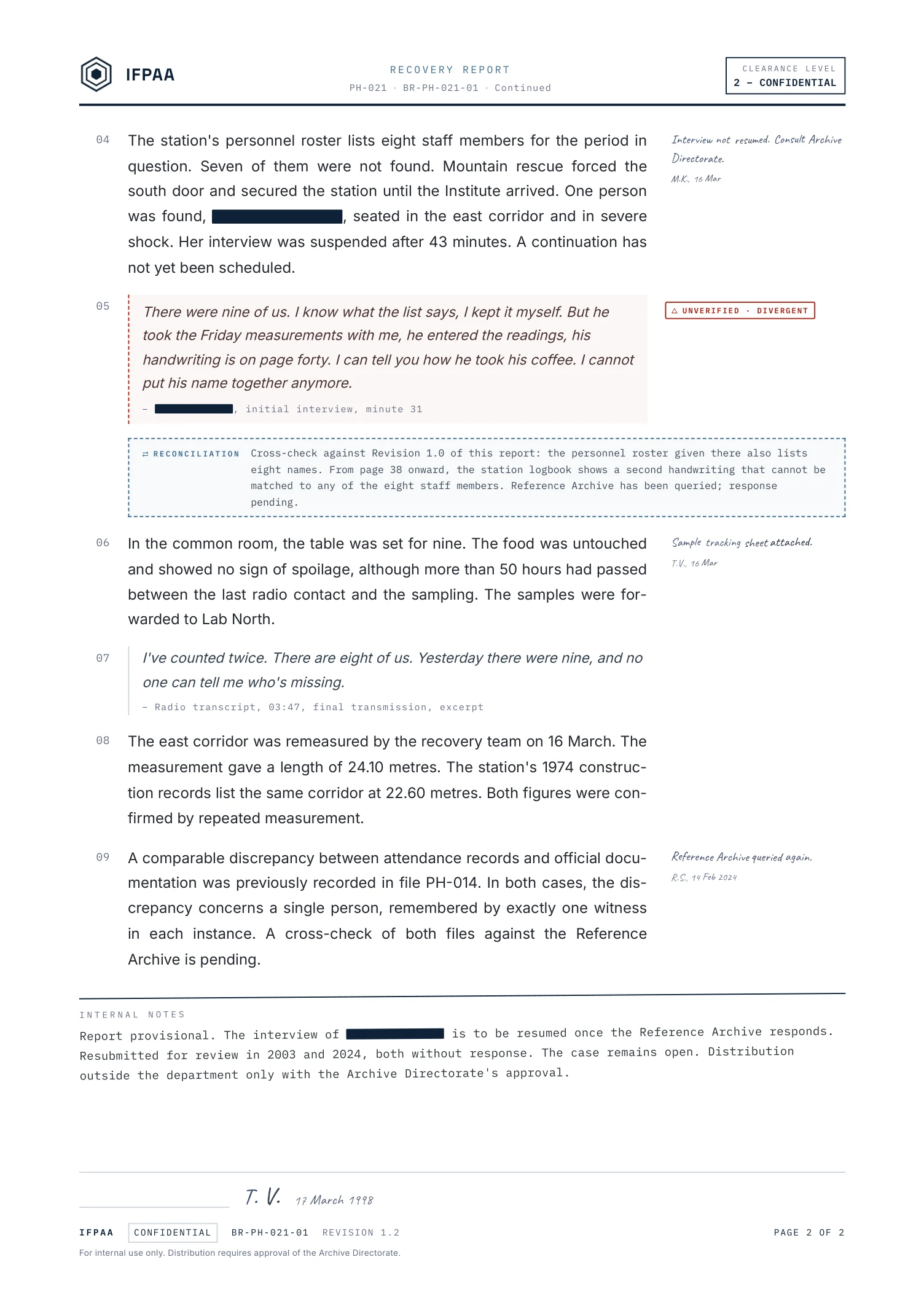
> AFFECTED: 7 MISSING · 1 RECOVERED · 1 WITH NO OFFICIAL RECORD
> RELATED FILES: PH-014 · PH-057 · ACCESS LOCKED
> WITNESS INTERVIEW: SUSPENDED AFTER 43 MINUTES
> NOTICE: THE DISPLAYED DATA DOES NOT NECESSARILY REFLECT THE CURRENT STATE OF OBSERVABLE REALITY.
> REFERENCE ARCHIVE QUERY OPEN SINCE 1998 · LAST RENEWED 2024
> READ CLEARANCE 2 GRANTED · DOCUMENT REMAINS INSTITUTE-INTERNAL
> GUEST ACCESS CONTAINS: RECOVERY REPORT BR-PH-021-01 · 2 PAGES
> FULL FILE REQUIRES REGISTRATION AS AN INVESTIGATOR
Internal Memo / Overview
Your analysis kit
The ADLAS-Core is your work surface: decoders, lenses, overlays, and measuring templates interlock on it and make visible what you would otherwise miss. You receive the kit once and work with it for years.
The digital investigation network
This is where the Institute's files live: reports, audio archives, map material, and personnel dossiers, built like an internal administrative system. Your clearance level decides which folders open and which stay shut.
One case leads to the next
Every case carries its own archive number, and its traces are spread across the equipment, across the archive, and across the world in between. Close one and files open up that were restricted before.
Internal memo · Equipment
Adaptive Decoding & Logical Analysis System
ADLAS is the Institute's analysis system. At its centre sits the ADLAS-Core: the work surface where you lay out a document and align the other tools on it.
Alongside it come optical aids, decoders, and templates for comparing, measuring, and making documents readable. None of these tools hands you an answer on its own. They open up another way of looking, and you draw the conclusion yourself.
Their real strength lies in combination. The same overlay that makes a map readable today shows something entirely different over a photograph in the next case. The more fluent you become with the tools, the more they give you.
What you hold in your hands are reproductions from the Institute's workshop. Originals do not leave the archive. For analysis, the replicas serve just as well.
Internal memo · System
Anomaly Investigation Management System
AIMS is the Institute's working tool, built like an internal administrative system. Investigation files, lab reports, audio archives, map material, personnel dossiers, and artifact databases come together here and grow with every investigation.
Between the case files, the ordinary business of an organisation carries on: internal circulars, interim updates on open matters, margin notes from earlier staff, later corrections to older reports. Not every entry belongs to your case.
Your clearance level decides what opens. Some matters appear only as an entry with no content, others stay fully restricted, a few accesses have to be found first. What you discover in one case can resurface years later in another.
One holding stays shut even then: the reference archive, against which the Institute checks whether a record has changed. Not even senior staff know where it is.
Internal memo · Casework
A case's clues sit on several levels: in the equipment, in the digital archive, in the world outside the system, and in your own head. An overlay leads to an archive number, the number to an audio recording, the recording to a phone number. Only the connection gives you the picture.
No case can be closed with a single tool, and none of them tells you where to start. The Institute supplies the material and records what was secured. Which conclusions follow from it is your call.
You get the entry once. After that you request new cases one at a time, or you stay on active duty: then the material arrives at your door as Institute mail, prepared the way internal dispatches to active investigators are.
A few matters are listed nowhere at all. Only those paying close enough attention find them.
From the Archive
EX-008
An expedition vanishes without a trace. Its journals keep being written for weeks afterward.
Status: Unresolved
SG-034
A radio signal has been broadcasting the same unknown message for decades. The source has never been found.
Status: Under observation
AR-032
An artifact appears to alter the memories of its owners. Three witnesses, three pasts.
Status: In containment
Extracts from the Institute's archive. The complete files are part of the investigations themselves.
The Institute
The Institute for Phenomena, Artifacts, and Anomalies keeps files on events that look like clerical errors at first. A date that cannot be right. A photograph with someone in it who never existed. Only when such errors start piling up and all point the same way does an investigation open.
A single contradiction would be explainable. What unsettles us is how quickly it disappears again: records fall into line, photographs too, eventually the memories of the witnesses, until everything fits together and no one can say what held true before. This is why the Institute maintains an archive that stays untouched by those corrections. It is the one fixed point we have. Without it, no one would notice anything had changed at all.
Not every one of these corrections is harmless. When a place disappears, sometimes the people who were there disappear with it, and the world settles as though they had never existed: no entry in any register, no one around them who misses them. Only those who were truly close still remember and grieve for someone whose existence not a single source will confirm. That one person who remembers, while everyone else has forgotten, is often the first reliable sign we get that something has happened.
Case Procedure
You get a file and the tools to examine it. Everything after that is yours: where you start, which contradiction you chase, when you decide you have enough. The Institute supplies the evidence. The conclusions are yours.
File PH-021 – Brocken High-Altitude Observatory A mountain station stops answering, every door is locked from the inside, and the tracks in the snow lead there but never back. You get whatever the recovery secured: the report, the station logbook, the radio transcript of the final transmission, and the statement of the only person still there.
In front of you is everything the recovery teams managed to secure, in the order it came in. Nothing tells you what belongs together. Some documents contradict each other, and those are usually the interesting ones.
An overlay from ADLAS reveals a string of numbers. The numbers lead to a case number in AIMS. And what you find there can take you far beyond your desk, to a phone number or a coordinate on a real map. No case can be solved with a single tool.
Every solved case expands your personal investigation file: new documents, new connections, and new questions. Because some answers open doors that were better left closed.
System Access · Partial Release
AIMS is the Institute's case management system. Your guest access includes a single released excerpt: the recovery report on File PH-021. Eight names were on the personnel roster, seven people were never found, and the one person recovered from the station insists there were nine of them. Click around. Everything else stays locked.
BR-PH-021-01 · Revision 1.2 Confidential
Photo documentation of east corridor and common room restricted
Locked in guest access. The full file opens once you join as an investigator.
Become an investigatorRadio transcript 03:47, final transmission, restricted
Locked in guest access. The full file opens once you join as an investigator.
Become an investigatorSample file for illustration. Registering does not unlock any content; it adds you to the interest list. Which cases make it into the finished Institute is not yet decided. Your feedback helps determine that, too.
Joining the Institute
The IFPAA doesn't exist yet: you help decide whether it gets built. Two short questions and your email address, done in under a minute. If you want to contribute more, open the in-depth survey afterward.
Your provisional case number: IFPAA-2026-000000
We have sent you a message. Confirm your address in it and your record is complete. Without that click it stays on hold and you will not hear from us again.
Nothing arrived? Check your spam folder.
Questions for the Institute
No. An escape game ends after an hour, a puzzle box after an evening. As an IFPAA investigator, you work on an ongoing story: your kit stays, every new case uses it in a new way, and the Institute keeps evolving with every case.
No. ADLAS makes evidence visible, but the solution only emerges once you connect it with the archives in AIMS and, sometimes, research outside the system. No case can be solved with a single tool.
The frame is set: the ADLAS kit with the ADLAS-Core, a first investigation case, and access to AIMS. Which tools go into it in detail, and what they will be made of, is being decided right now. That is exactly what this page is for: your answers feed straight into those decisions.
Getting started is a one-time purchase: the ADLAS kit with the ADLAS-Core, your first investigation case, and access to AIMS. After that you request each new case on its own, or you stay on active duty. That is a subscription with a recurring fee: new case material then arrives at your door as Institute mail without you ordering each time. It adds to buying individually, never replaces it, and you can cancel at any time. The details are taking shape now, with your feedback included.
Yes. Every case can be solved entirely on your own. Joint investigations with friends and exchanging findings with other investigators are possible, but never required.
How extensive individual cases will be is decided only after this validation phase, with your feedback included. What's clear: you investigate at your own pace, with no time pressure. Cases won't run away.
They go exclusively onto our recruitment list for this project. You'll get occasional progress updates and hear about the launch first. No advertising, no sharing, unsubscribe with one click.
The recruitment phase is already underway, and the Institute is being built. With your registration and your answers, you help decide whether and how the IFPAA gets built. Founding investigators get ongoing insight into development and a say in the decisions.